
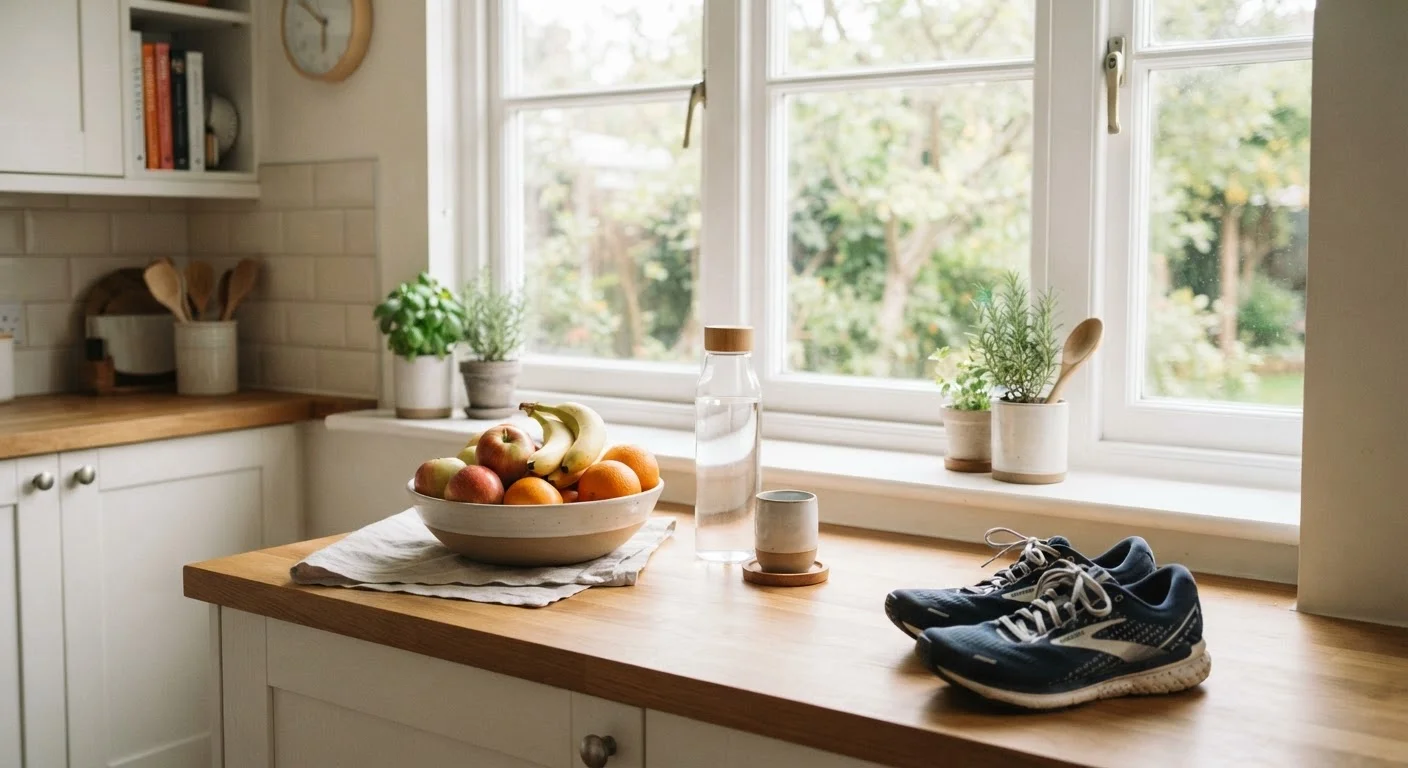
Why Environment Outpaces Willpower
Most people approach behaviour change as an internal battle - a test of discipline and motivation. Behavioural science tells a different story. Research in environmental psychology consistently shows that the cues and structures surrounding us drive a significant portion of our daily decisions, often before conscious deliberation kicks in.
Willpower is a limited resource that fluctuates with stress, sleep, and time of day. Your environment, by contrast, works continuously. A well-designed space keeps nudging you toward healthier choices even on low-energy days. Understanding this shifts the goal from trying harder to designing smarter. For a deeper look at the neurological side of this process, see how behaviours become automatic.
“Every choice you make is shaped by the context in which you make it. Change the context, and you change the choice - often without needing to change the person at all.”
— B.J. Fogg, Behavioral scientist and author, Stanford Behavior Design Lab
Best Practices for Designing a Health-Supporting Environment
The following practices are grounded in behavioural research and practical habit-design principles. Each targets a specific lever in your environment that influences daily health choices.
Place healthy defaults within arm's reach and hide less healthy alternatives.
Proximity dramatically affects how often we choose something. Studies on food placement show that items at eye level or in plain sight are consumed far more frequently than those stored out of view. The same principle applies to exercise equipment, water bottles, and supplements.
Use environmental cues to trigger habits at consistent times and places.
Habits form when a behaviour is reliably paired with a specific context - a location, object, or time. Pairing your intended habit with an existing anchor in your environment accelerates the automaticity of the new behaviour.
Add friction to behaviours you want to reduce.
Just as removing friction makes healthy choices easier, adding friction to disruptive habits creates a useful pause. Even a small increase in effort - an extra step, a password, a physical barrier - reduces the automatic pull of a less helpful behaviour.
Design your space to support <a href="/home-living/daily-routines/what-makes-a-daily-routine-actually-stick">a daily routine that sticks</a>.
Routines become stable when the physical environment reinforces their sequence. When your space is set up so that one action naturally flows into the next, the cognitive load of maintaining a routine drops considerably.
Curate your digital environment with the same intentionality as your physical one.
Screens are part of your environment. App placement, notification settings, and browser bookmarks all nudge you toward certain behaviours. An unmanaged digital environment often competes directly with physical health goals.
Quick Wins You Can Apply Today
You don't need to renovate your home or overhaul your social circle to start benefiting from environmental design. These immediate actions create positive ripple effects with minimal effort - a useful companion to the broader principles in building healthy habits from scratch.
Start With One Room
Redesigning your entire environment at once can feel overwhelming and often leads to inaction. Instead, pick the single room where most of your target habit will occur - the kitchen for eating, the bedroom for sleep - and make two or three targeted changes there first. Small, specific wins build momentum for broader adjustments over time.
The Social Layer of Your Environment
Physical space is only one dimension of environment. The people you spend the most time with form a social environment that shapes your norms, expectations, and daily behaviour. Research in social psychology suggests that health behaviours - including exercise frequency, eating patterns, and sleep timing - cluster among social groups.
This doesn't mean cutting off friends with different habits. It means being intentional: seek out one or two people whose routines align with the health direction you want to move in. A walking partner, a friend who cooks regularly, or an online community centred on a shared goal can all function as environmental supports. For related ideas on everyday habits that support your mental balance, explore small daily habits that support emotional wellbeing.
Social Influence Works Both Ways
The same social dynamics that support healthy habits can also reinforce less healthy ones. This isn't a reason for self-criticism - social contagion of behaviour is a well-documented, largely unconscious process. Recognizing it gives you the ability to make more deliberate choices about the groups and norms you engage with most regularly.
~35%
Daily behaviours estimated to be habitual
Research published in the journal Personality and Social Psychology Bulletin estimated that roughly a third of daily actions are performed habitually in the same location each day.
3x
Increase in healthy food consumption with better placement
Studies on cafeteria environments have found that making healthier options more visible and accessible can more than double - sometimes triple - the rate at which people choose them.
This article is for general informational and educational purposes only. It is not a substitute for professional medical or mental health advice. Consult a qualified healthcare professional before making significant changes to your health routines, especially if you have an existing health condition.