
Why Shopping Myths Are So Persistent
Shopping myths survive because they feel intuitively sound. Who would argue against buying more for less, or collecting points on spending you'd do anyway? The problem is that these ideas rest on assumptions - about behaviour, discipline, and market honesty - that frequently don't hold up in practice.
Understanding where the logic breaks down isn't about becoming a cynical consumer. It's about making decisions based on what a purchase actually costs you rather than what a price tag or promotion implies. The principles of saving money consistently point to the same conclusion: awareness of how spending decisions are framed matters as much as the prices involved.
Myth
If something is on sale, buying it is saving money.
Fact
Buying something you didn't plan to purchase is spending, regardless of the discount applied.
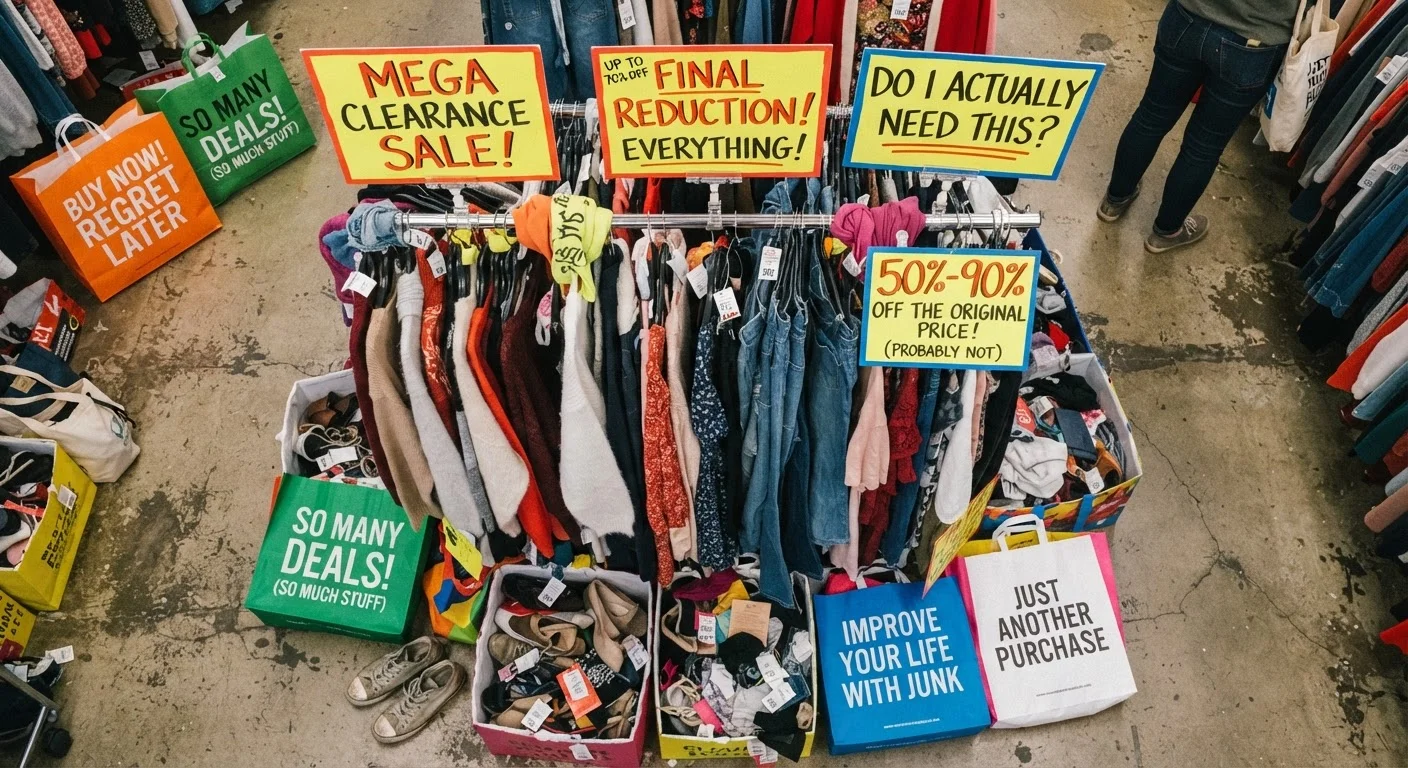
This is the foundational shopping myth, and it's remarkably durable. The word "saving" implies that money stays in your pocket - but any unplanned purchase takes money out. A 40% discount on an item you didn't need before you saw the promotion means you spent 60% of its price unnecessarily. Retailers understand this deeply, which is why sale events are designed to drive discovery of items, not just reward planned purchases. Anchoring and urgency tactics are specifically engineered to make the spending feel like responsible behaviour.
Myth
Buying in bulk always works out cheaper in the long run.
Fact
Bulk buying only saves money when you use all of what you purchase before it expires or degrades.
The per-unit cost of a bulk pack is frequently lower - that part is usually true. The problem lies in what happens next. Perishable goods spoil, non-perishables take up storage space and cash flow, and consumer habits shift. A large quantity of a product you later stop using is not a saving - it's a sunk cost. When bulk buying actually pays off depends heavily on your household's realistic consumption rate, not the unit price on the label.
Myth
Loyalty programme points and cashback rewards are essentially free money.
Fact
Rewards have real value only when redemption conditions are met and the spending required to earn them was already planned.
Loyalty schemes are structured to encourage incremental spending - often more than the reward is worth. Points expire, categories are restricted, minimum redemption thresholds apply, and the behaviours required to "earn" efficiently frequently involve spending you wouldn't otherwise make. Cashback cards carry similar logic: if carrying a rewards card leads to even modestly higher monthly spending, the reward earned rarely offsets the additional outlay. Before crediting a programme as genuinely beneficial, tally up what you've spent specifically to earn or maintain your reward status.
Myth
A higher original price means a bigger genuine discount.
Fact
"Original" prices are sometimes set artificially high to make the sale price appear more attractive - a tactic known as price anchoring.
Price anchoring is a well-documented retail practice: presenting a high reference price alongside a lower sale price makes the sale price feel like a significant bargain, regardless of what the item actually costs elsewhere or what it has historically sold for. Consumer protection guidelines in the US address this, but enforcement is inconsistent. A useful counter-habit is checking price history tools or third-party comparison sources before assuming a stated original price reflects what the item genuinely sold for. Terms and conditions of promotions often contain the clearest signals of how a deal is actually structured.
Myth
Shopping sales is a reliable strategy for staying within budget.
Fact
Sale-driven shopping tends to increase total spending by adding unplanned items, even when individual items are discounted.
Budget discipline is about controlling total outflow, not optimising individual transactions. A shopping trip anchored around a sale event typically results in a larger basket than one built around a pre-written list. Each discounted item feels individually justified, but collectively the outing often exceeds what a non-sale, list-based trip would have cost. Running a pre-purchase checklist before any sale visit helps separate genuine planned value from opportunistic spending dressed up as savings.
What Smart Consumer Habits Actually Look Like
Correcting these myths doesn't require elaborate systems. It mostly requires one habit: deciding what you need before you encounter a promotion, rather than letting the promotion decide for you. A written list - even a rough one - dramatically reduces the influence of in-store or online sale environments on what ends up in your basket.
Urgency Cues Are a Sales Tactic
Phrases like "today only," "limited stock," or "selling fast" are designed to short-circuit deliberate decision-making. Research in consumer psychology consistently shows that artificial time pressure increases impulsive purchases and reduces satisfaction with buying decisions. Before acting on urgency, pause and ask whether you needed the item before you saw the promotion.
It's also worth periodically auditing where your money actually goes. Reviewing recurring and hidden costs often reveals that the real savings opportunity isn't in shopping smarter at sales - it's in identifying what you've been quietly paying for and no longer need.
~40%
Of purchases made on impulse
Multiple consumer behaviour studies estimate that roughly 40% of purchases in retail environments are unplanned, with promotional signage being a primary trigger.
3 in 10
Bulk items wasted before use
Estimates from food waste research suggest a significant proportion of bulk-purchased perishables are discarded before consumption, eroding the unit-cost saving.
For a broader look at how these same patterns appear in financial thinking, common money myths that prevent saving tend to share the same structure: a belief that sounds reasonable on the surface but quietly works against your financial interests when examined closely.
Spending More Is Never "Saving"
No matter how large the stated discount, any unplanned purchase represents spending, not saving. A genuine saving only occurs when you pay less for something you were already committed to buying. Retailers design sale environments to blur this line - being aware of it is your most effective defence.
This article is for general informational and educational purposes only and does not constitute personalised financial advice. For guidance tailored to your individual circumstances, consult a qualified financial professional.