
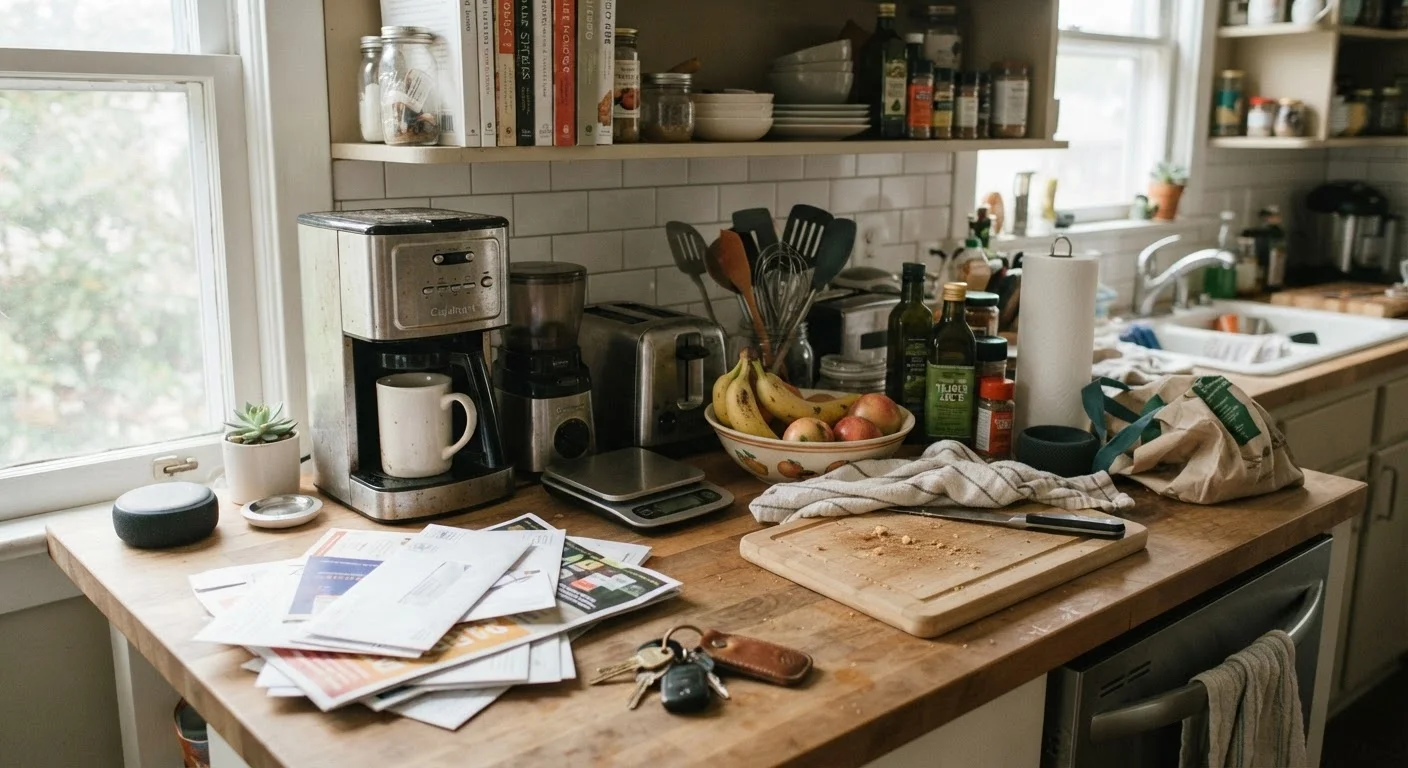
Why Your Countertops Feel Like Magnets
You clean off the kitchen counter on Saturday. By Wednesday, it's buried again. Sound familiar? This cycle isn't a willpower problem - it's a behavioral one. Flat, open surfaces trigger what organizational researchers call a deposit reflex: when you walk in the door carrying something, your eyes scan for a horizontal surface and your hands let go. The counter wins every time because it's convenient, visible, and offers no resistance.
Understanding the specific habits that feed this cycle is the first step toward breaking it. The mistakes below are the most common culprits - and each one has a practical fix.
Treating flat surfaces as a general-purpose 'landing zone' with no designated purpose.
Why it happens: When a surface has no defined function, it defaults to holding whatever is convenient. Without a clear rule for what belongs there, everything belongs there.
Putting items down with the intention of dealing with them 'in a minute.'
Why it happens: Short-term thinking is a normal cognitive shortcut. The brain prioritizes the immediate task and defers the secondary one - but that secondary task rarely gets revisited.
Lacking a permanent home for frequently used items like keys, mail, and chargers.
Why it happens: Items without assigned storage migrate to wherever they were last used. Over time, the counter or table becomes their unofficial home simply through repetition.
Doing a full purge without changing the underlying habits that caused the pile-up.
Why it happens: Cleaning feels productive and satisfying, which can make it easy to assume the problem is solved - until the same surface fills up again within days.
Keeping items on surfaces 'just in case' they're needed soon.
Why it happens: Anticipating future needs feels practical, but it often leads to semi-permanent clutter that is rarely actually used from the surface where it sits.
How to Build a Home That Stays Clear
Fixing surface clutter isn't about cleaning more often - it's about designing your environment so that the easy choice and the tidy choice are the same thing. Start by walking through your home and identifying which flat surfaces collect the most items. For most households, it's the kitchen counter near the entry, the dining table, and a bedroom dresser.
Avoid the 'Clean Sweep' Trap
Doing a dramatic all-at-once cleanout can feel motivating, but without addressing the habits that created the pile-up, surfaces typically refill within two to three weeks. Focus on systems - not just single cleaning sessions - for lasting results.
Once you've identified your problem surfaces, consider two design moves. First, reduce available surface area where possible - a surface that holds a plant or a lamp simply holds less clutter. Second, place a small, attractive bin or tray nearby for items that genuinely need a temporary landing spot. A tray with a defined edge creates a visual boundary that naturally limits how much can accumulate.
If clutter still feels emotionally overwhelming even after you've tidied up, it may be worth exploring why disorganized spaces affect your mental state - the cognitive connection between clutter and stress runs deeper than most people expect.
1 hour
Time lost weekly searching for misplaced items
Research by the National Association of Professional Organizers has estimated that the average American spends roughly an hour per week looking for things they own but cannot locate.
40%
Of household clutter linked to disorganization, not excess stuff
Organizational studies frequently find that a significant portion of home clutter exists not because people own too much, but because items lack assigned storage locations.
Finally, build a daily one-minute reset habit. Before a meal or before bed, scan one target surface and return items to their assigned homes. Consistency over a few weeks tends to make the habit automatic - and the surfaces start staying clearer on their own.