
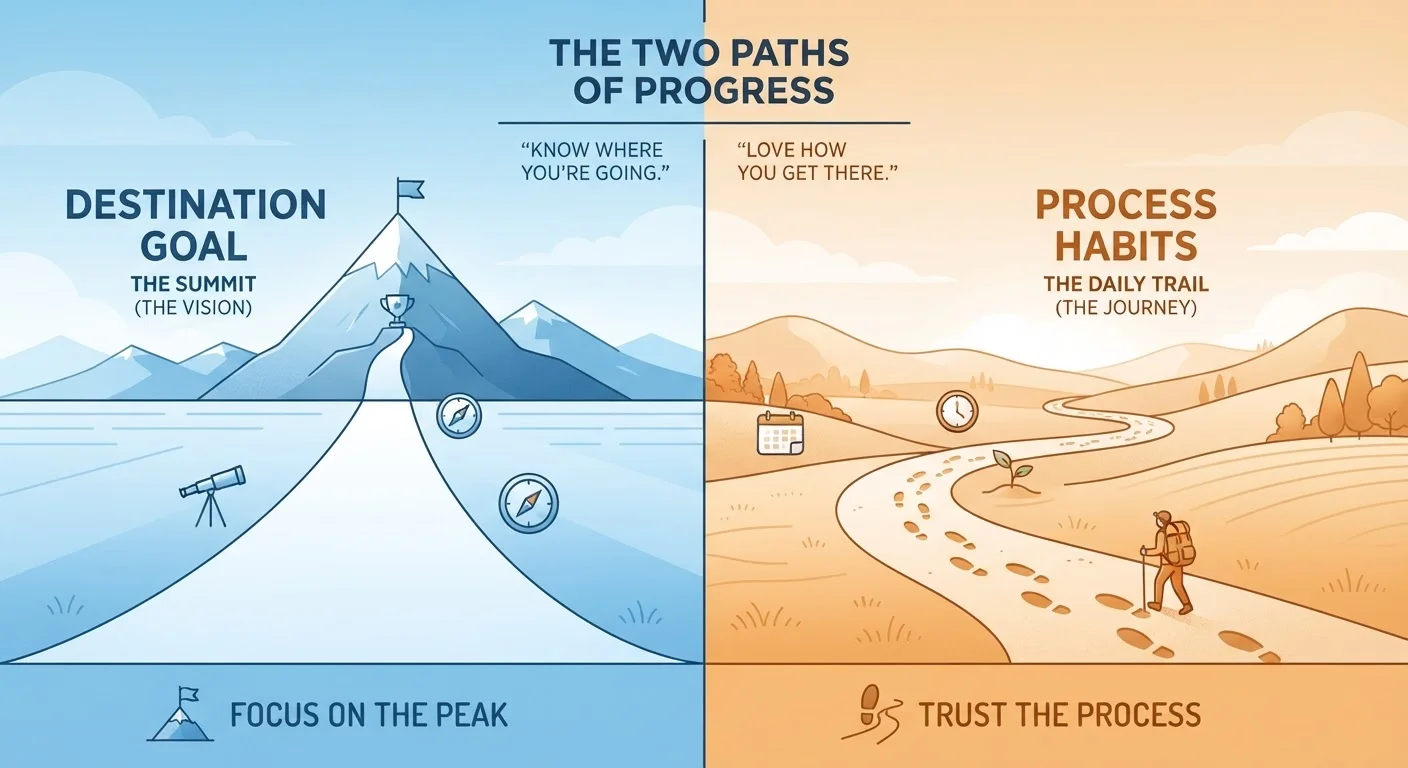
What Each Type of Goal Actually Means
In goal-setting frameworks developed across sports psychology, behavioral research, and productivity science, goals generally fall into two categories: outcome goals and process goals. Both are legitimate - but they operate on different levels and serve different psychological functions.
An outcome goal defines a specific end-state you want to reach. In personal finance, that might look like: "Save $10,000 in an emergency fund by December" or "Pay off my credit card balance within 18 months." These goals are measurable, finite, and clearly signal whether you've succeeded. Understanding what financial goals actually are is the first step - and outcome goals are usually what people picture when they hear the phrase.
A process goal, by contrast, targets a behavior rather than a result: "Transfer $200 to savings every payday" or "Review my budget every Sunday evening." Process goals are entirely within your control because they describe actions, not outcomes that depend on external variables like market performance or unexpected expenses.
The distinction matters because the two types of goals fail in different ways - and succeed for different reasons.
How Outcome Goals Help - and Where They Fall Short
Outcome goals are useful for establishing direction. They answer the question "What am I actually working toward?" and create a benchmark you can measure progress against. A clear destination also makes it easier to communicate your priorities to a partner, hold yourself accountable, and feel a genuine sense of completion when you arrive.
Applying a structured framework like SMART helps sharpen outcome goals so they're specific and time-bound rather than vague wishes. Vague intentions like "save as much as possible" illustrate what happens when outcome goals aren't defined precisely - they feel productive but rarely drive real behavior.
The weakness of outcome goals is that results often lag effort, and some factors influencing the outcome are simply outside your control. If you set a goal to grow your investment account by a fixed percentage and markets decline, the outcome goal can feel punishing even when your behavior has been sound. Over-reliance on outcomes can also create an all-or-nothing mindset: if the target seems unreachable, motivation collapses entirely.
| Criterion | Outcome Goals | Process Goals |
|---|---|---|
| Focus | End result or milestone | Daily or weekly behavior |
| Control level | Partly external (markets, income) | Fully within your control |
| Motivational style | Destination-driven, aspirational | Habit-driven, routine-based |
| Risk when missed | Discouragement, all-or-nothing thinking | Drift without a clear purpose |
| Best use | Setting direction and benchmarks | Maintaining consistency over time |
| Example | Save $10,000 in 12 months | Transfer $200 every payday automatically |
| Measurement | Balance, date, milestone reached | Action completed: yes or no |
How Process Goals Sustain Financial Momentum
Process goals shift the focus from what you hope will happen to what you will reliably do. Because they're behavior-based, they're immune to the volatility that can derail outcome-focused plans. You can hit every process goal in a given month and still face a surprise car repair - but you've preserved the habit, and the habit is what compounds over time.
Research in behavioral psychology consistently suggests that habit formation depends more on consistent repetition than on outcome-based reward. In financial terms, automating a monthly savings transfer is a process goal that works even when you're not feeling particularly motivated. Reviewing spending categories weekly is a process goal that keeps you informed regardless of whether your balance is growing as fast as you hoped.
40%
Of daily actions driven by habit, not decisions
Research published in the journal Psychological Science estimates that roughly 40% of everyday behaviors are habitual - highlighting why process-based goals can outperform willpower-dependent plans.
66 days
Average time to form a new habit
A study by University College London researchers found that new behaviors take an average of 66 days to become automatic - underscoring the value of process goals over short-term outcome sprints.
Process goals also reduce decision fatigue - a real cost in personal finance, where small daily choices accumulate. When the behavior is predetermined and habitual, you spend less mental energy debating whether to follow through. That said, process goals without a destination can drift. Saving consistently without knowing what you're saving for can leave you feeling busy but directionless. This is where outcome goals play an essential role as anchors.
Combining Both Goal Types in Practice
The most effective financial plans don't choose sides - they layer process goals beneath outcome goals. Think of outcome goals as the destination and process goals as the scheduled stops that get you there reliably.
Here's a practical example: An outcome goal might be to build a three-month emergency fund within one year. Nested beneath it, a process goal would be to automatically transfer a fixed amount each payday without exception. The outcome goal tells you why the behavior matters; the process goal tells you exactly what to do each week regardless of how far away the finish line feels.
Matching goal horizons to the right timeframe also strengthens this layered approach - short-term process goals often feed medium- or long-term outcome goals. And if you're starting from scratch, building a financial goals plan from the ground up walks through how to structure both goal types into a coherent, prioritized system.
When Outcome Goals Need to Flex
Life events - a job change, a medical expense, a shift in income - can make a fixed outcome goal temporarily unrealistic. Rather than abandoning the goal entirely, consider adjusting the timeline or the target amount while keeping your process goals intact. Preserving the habit is often more valuable than hitting the original number on schedule.
When one goal type isn't working - motivation is low, or progress has stalled - it's often a sign to examine the other type. Stalled outcome? Check your process. Consistent process but no clear direction? Revisit your outcome.
This article is for general informational and educational purposes only and does not constitute personalized financial advice. For decisions specific to your situation, consult a qualified financial professional.