
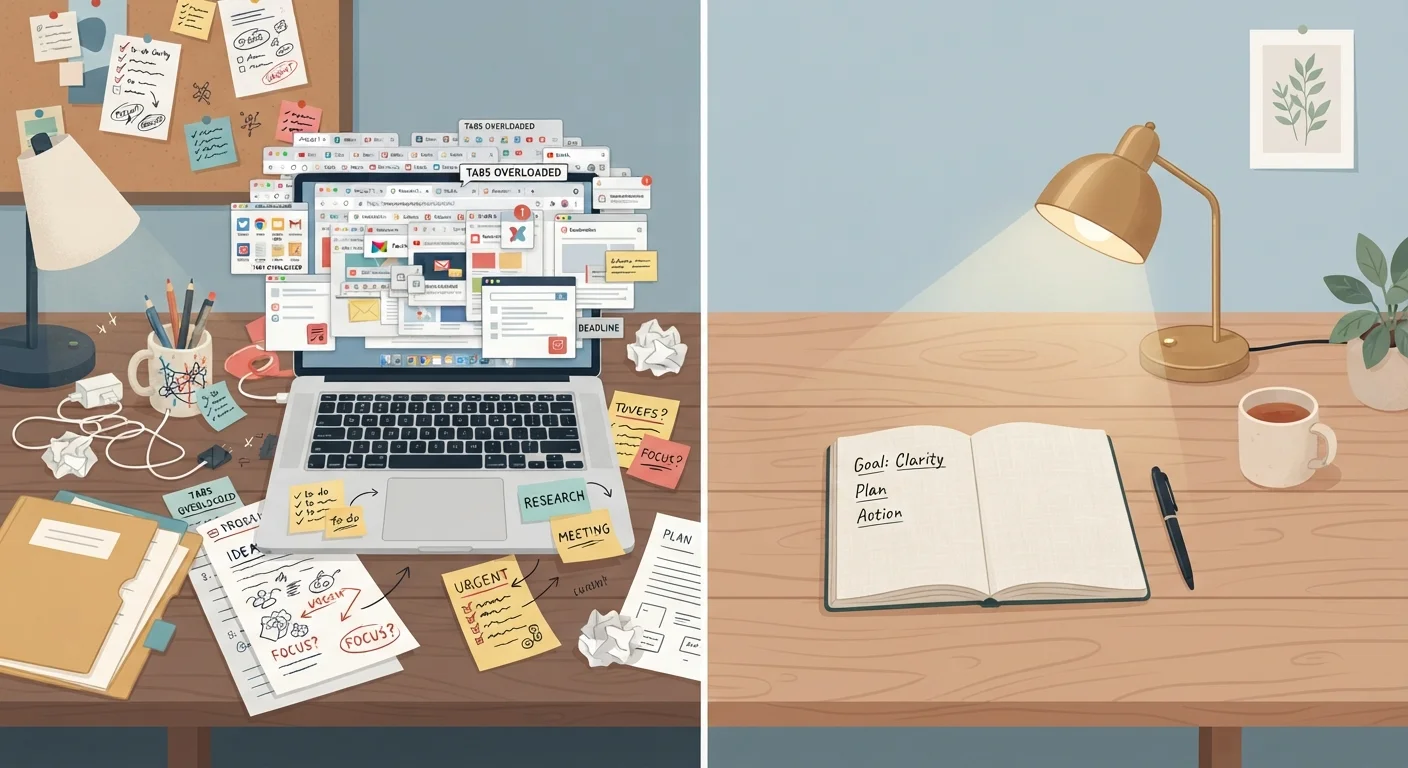
Why Productivity Myths Are So Sticky
Productivity advice is everywhere - and a surprising amount of it contradicts what cognitive science actually shows. The myths persist partly because they feel intuitive and partly because short-term behavior can seem to confirm them. Someone who juggles email, messages, and a report simultaneously might feel extraordinarily busy. Whether they're producing better work is a separate question entirely.
This article separates five widely held productivity beliefs from what the research literature suggests is actually happening. Understanding the gap between myth and mechanism gives you a clearer foundation for building work habits that hold up under real conditions. For a broader look at evidence-based attention strategies, see the Focus Toolkit.
Myth
Multitasking lets you get more done in less time by running tasks in parallel.
Fact
The human brain doesn't process multiple complex tasks simultaneously - it switches rapidly between them, and each switch carries a measurable cost.
Cognitive researchers use the term task-switching cost (sometimes called the "switch cost effect") to describe the performance penalty incurred when attention moves between different tasks. Studies published in peer-reviewed journals including the Journal of Experimental Psychology have consistently found that switching increases error rates and slows completion time - even when the switching feels seamless. What feels like parallel processing is actually serial processing with friction added. For cognitively demanding work like writing, analysis, or coding, the cost compounds quickly.
Myth
You can trigger a flow state whenever you need one by just sitting down and concentrating hard.
Fact
Flow - the state of deep, effortless absorption described by psychologist Mihaly Csikszentmihalyi - emerges from specific conditions and cannot simply be willed into existence.
Csikszentmihalyi's research identified a core condition for flow: the challenge level of a task should roughly match the skill level of the person doing it. Too easy, and attention drifts; too hard, and anxiety blocks absorption. Beyond task calibration, environmental conditions matter: uninterrupted time, a clear goal, and immediate feedback on progress all support flow's emergence. You can design conditions that make flow more likely - but the experience itself isn't directly controllable. Treating it as a switch you flip leads to frustration; treating it as a climate you cultivate is more accurate and more actionable.
Myth
Being constantly available and responsive is a sign of professionalism and high performance.
Fact
Continuous partial attention - the state of always being somewhat available - is associated with higher cognitive load and lower quality output on complex tasks.
The always-on expectation in many workplaces conflates responsiveness with productivity. These are not the same thing. Research on cognitive load suggests that the mere presence of a smartphone on a desk - even face down - reduces available working memory because the brain allocates resources to monitoring it. Compulsive inbox-checking creates a fragmented attention pattern that makes sustained analytical thinking harder to access. Being strategic about when you're available, rather than always available, is increasingly supported by organizational psychology as a performance advantage - not a professional risk.
Myth
If you have enough willpower, you can focus deeply anywhere and anytime.
Fact
Willpower is a limited and fluctuating resource; environment design is a more reliable focus strategy than self-discipline alone.
The concept of ego depletion - the idea that self-control draws from a finite pool - has had a complicated research history, with some replication studies producing mixed results. What remains broadly supported, however, is that decision fatigue is real and that relying solely on in-the-moment resolve is an inefficient focus strategy. Behavioral science consistently shows that removing friction (closing tabs, silencing notifications, using a dedicated workspace) produces more durable focus than fighting distraction after it appears. Environment shapes behavior more reliably than intention does. Building structured daily routines around these principles tends to produce more consistent results than motivational bursts.
Myth
More hours worked always means more accomplished - productivity scales with time input.
Fact
Output quality, especially for complex cognitive work, tends to plateau or decline after a threshold of sustained effort - more hours past that point often produce diminishing or negative returns.
Early 20th-century industrial research first documented that reducing working hours sometimes increased total output by reducing errors and fatigue. For knowledge work, the evidence points toward similar patterns: sustained high-quality cognitive output appears to be sustainable for roughly four to six hours per day for most people, with significant individual variation. Working beyond fatigue doesn't just slow you down - it increases the probability of errors that require rework. The implication isn't a specific hour cap; it's that tracking time worked is a poor substitute for tracking meaningful output. See also how routine myths compound this problem.
What the Evidence Actually Supports
Correcting these myths isn't just academically satisfying - it changes practical decisions. If multitasking degrades output quality, then open-plan notification culture has a real cost worth measuring. If flow requires setup conditions, then randomly hoping to "get in the zone" is a poor strategy. And if constant availability signals competence to peers or managers, that social pressure needs to be named before it can be managed.
23 min
Average time to regain deep focus after an interruption
Commonly cited figure drawn from workplace attention research by Gloria Mark at the University of California, Irvine, examining knowledge worker focus recovery.
40%
Productivity loss attributed to task-switching
Research cited by the American Psychological Association suggests switching between tasks can reduce productive output by as much as 40% in complex work scenarios.
~4 hrs
Estimated peak daily deep-focus capacity for most adults
Consistent with findings across studies of expert performers and knowledge workers reviewed in deliberate practice and cognitive fatigue literature.
The productive sweet spot for most knowledge workers involves deliberate periods of single-task focus, realistic transition time between contexts, and explicit permission to be unreachable for stretches of the day. None of that requires a specific app or framework - it requires accurate beliefs about how attention works. If your current system keeps breaking down, diagnosing why is a more useful next step than adopting another tool.
Busyness Is Not a Productivity Metric
Tracking hours, messages sent, or tasks checked off can create a convincing illusion of progress while masking shallow output. Before redesigning your schedule, identify what 'done well' actually looks like for your highest-priority work - then measure against that, not against effort signals. If your app setup is adding to the noise rather than reducing it, these signals are worth reviewing.
Distinguishing effort that moves the needle from effort that merely feels productive is one of the more consequential mindset shifts in personal effectiveness. The deep work vs. shallow work distinction offers a useful framework for making that call consistently.