
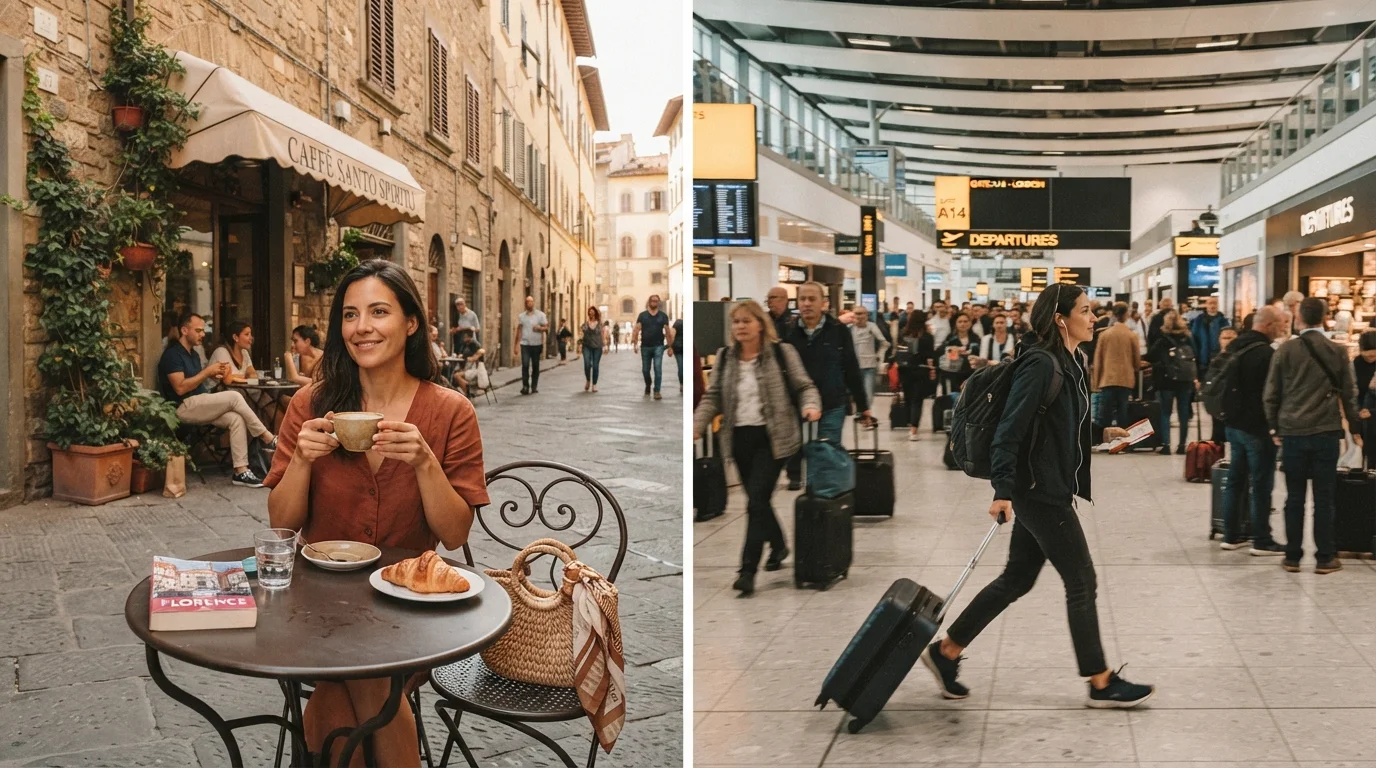
Where the Money Actually Goes in Each Approach
The cost difference between slow travel and fast-paced itineraries isn't just about nightly rates - it's about how spending compounds across an entire trip. When you move cities every one to two days, you're not just paying for a new bed. You're paying for transit again, possibly checked luggage fees again, new SIM cards, orientation meals in tourist-facing restaurants, and entrance fees to landmark attractions that cluster around first-time visitors.
Slow travelers, by contrast, absorb those one-time costs across more days. A €70-per-night apartment rented for a week often drops to €50 per night with a weekly discount - or lower on platforms designed for extended stays. Groceries replace restaurant meals for breakfasts and lunches. A transit card paid once covers daily life rather than single airport runs. These aren't dramatic savings individually, but together they reshape your daily spend rate considerably.
For a grounded look at how these trade-offs play out across specific budget decisions, see how cheap choices can quietly cost more - a principle that applies equally to itinerary pacing.
| Criterion | Slow Travel | Fast-Paced Itineraries |
|---|---|---|
| Accommodation cost | Lower - weekly rates common | Higher - nightly pricing only |
| Transportation spend | Low - minimal city-to-city transit | High - frequent trains/flights |
| Food costs | Lower - grocery access, local spots | Higher - tourist-area convenience |
| Luggage fees risk | Low - lighter packing, laundry access | Higher - overpacking common |
| Destinations covered | Few - deep focus on one or two | Many - broad geographic coverage |
| Decision fatigue | Low - familiar surroundings | High - constant reorientation |
| Ideal trip length | 3+ weeks | 1-2 weeks |
| Best for | Budget optimization, cultural depth | First-time regional overview |
The Hidden Costs of Constant Movement
Fast-paced itineraries carry several costs that don't appear on any booking confirmation. Transit time is the most obvious: a day spent on trains or in airports is a day not spent experiencing your destination - yet it still costs money in transport, food, and accommodation at either end. Arrive late after a flight delay and you may pay for a taxi instead of a cheaper shuttle, or miss a pre-booked dinner reservation.
There's also the cost of decision fatigue. Navigating a new city every 48 hours means constant orientation - new transit systems, new neighborhoods, new menus, new currency dynamics. That mental load often pushes travelers toward convenience spending: tourist-area restaurants, guided tours that cover basics, and taxis over public transit.
2-3×
Transport cost multiplier for multi-city trips
Travelers moving between cities every one to two days can spend two to three times more on transit than those staying in one location for a week, based on common European and Southeast Asian travel cost analyses.
~30%
Average savings on weekly vs. nightly rental rates
Short-term rental platforms frequently offer discounts of 20-35% for stays of seven nights or more compared to equivalent nightly pricing, according to general market observations.
60%
Travelers reporting fatigue affects enjoyment
A commonly cited travel wellbeing finding suggests the majority of multi-destination travelers report that physical fatigue reduced their enjoyment of at least one destination on fast-paced trips.
Luggage is another underappreciated budget factor. Slow travelers tend to pack lighter because they can do laundry; fast-paced travelers often overpack to avoid laundromat detours, which increases checked bag fees and slows them down physically. If you're evaluating how to structure a trip without overscheduling, the luggage and pacing connection is worth considering early in the planning process.
What Each Style Actually Buys You (Beyond the Dollar Amount)
Budget analysis only tells part of the story. What you get for your money differs fundamentally between these two approaches - and that shapes whether either represents good value for your particular goals.
Slow travel tends to buy depth: a working knowledge of a neighborhood's layout, relationships with the same café owner across a week, an understanding of local rhythms. That familiarity often leads to better decisions - you learn which market has the freshest produce, which transit line to avoid at rush hour, which museum has free entry on Thursdays.
Fast-paced itineraries buy breadth: the claim of having stood in multiple cities, the visual variety of different landscapes or cultures within a single trip, and a sense of momentum that many travelers find energizing. For people with limited annual leave, this can be the more practical trade-off - experiencing more in the time available, even at higher daily cost.
Neither delivers more inherent value - they deliver different kinds of value. The key is matching the approach to what you actually want from a trip, not defaulting to whichever style feels more ambitious. For more on aligning your approach with your available time, the short-trip vs. extended-trip planning guide offers a useful framework. And if your main constraint is budget, stretching a travel budget without sacrificing the experience covers how pacing fits into broader spending strategy.
A Hybrid Approach Is Valid
Many experienced travelers use a mixed model: one or two anchor cities with longer stays, plus one or two shorter stops in between. This captures some cost efficiency of slow travel while preserving geographic variety. The key is building in at least one rest day per week and identifying which destinations warrant depth versus a brief visit. Planning this balance early prevents the itinerary from collapsing into exhaustion mid-trip.