
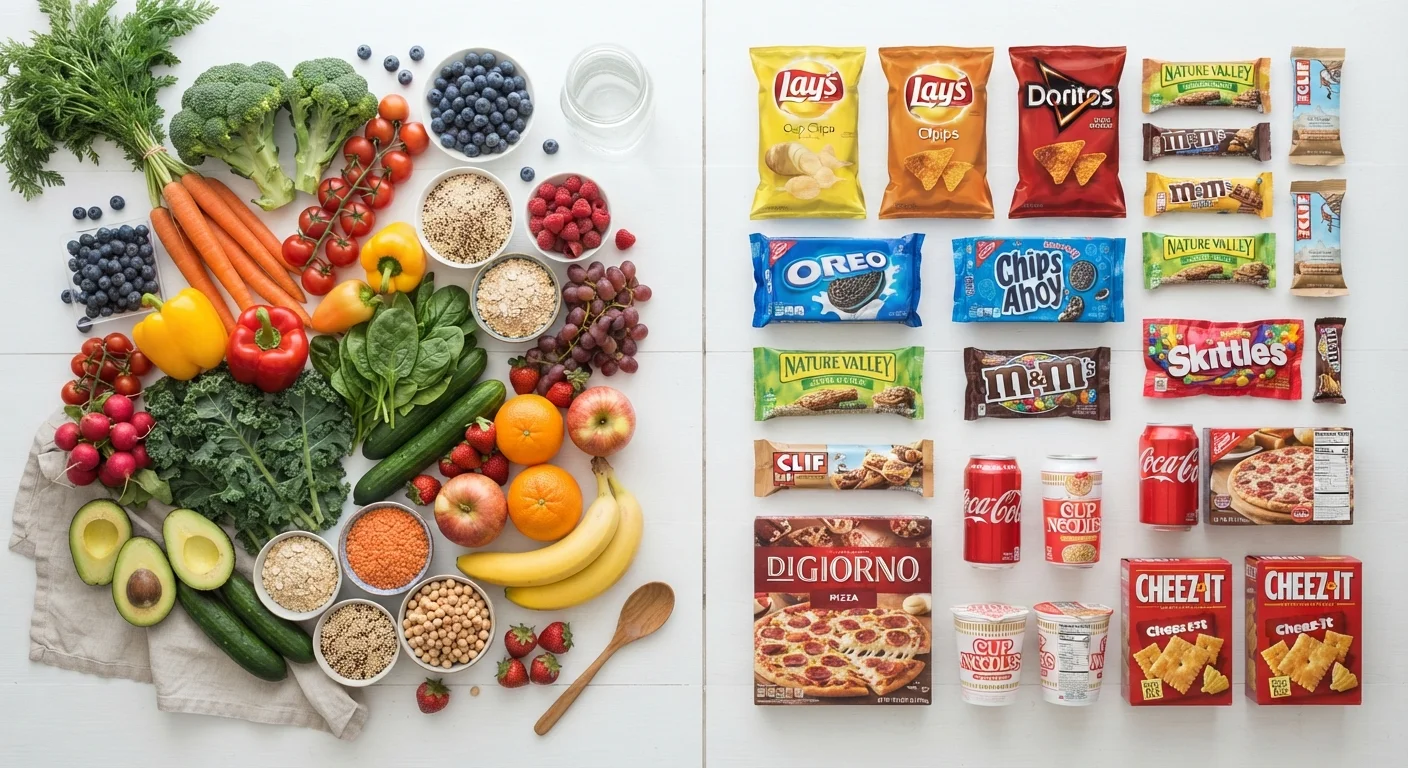
What 'Whole' and 'Processed' Actually Mean
The word whole food refers to any food eaten in - or very close to - its natural form. Think an apple, a handful of walnuts, a raw chicken breast, or a cup of dried lentils. These foods have not been substantially altered from the state in which they exist in nature, so their nutritional profile remains largely intact.
Processed food, by contrast, covers an enormous range. By definition, any food that has been changed from its original state through cooking, freezing, canning, drying, or adding ingredients counts as processed. That means frozen peas, canned tomatoes, and rolled oats are technically processed - yet nutritionally, they look quite different from a packaged snack cake or a fast-food meal.
Nutrition researchers often use the NOVA classification system to distinguish processing levels: from minimally processed (frozen spinach, plain yogurt) to culinary ingredients (olive oil, flour) to processed foods (cheese, smoked fish) and finally to ultra-processed foods - products formulated with combinations of industrial ingredients, additives, flavors, and preservatives rarely used in home cooking.
The NOVA System Is a Research Tool, Not a Label
NOVA classifications are used by nutrition researchers and public health bodies to study dietary patterns at a population level. You won't see NOVA categories on grocery packaging. Instead, use ingredient lists and nutrition facts panels as your practical guide. The shorter and more recognizable the ingredient list, the closer a food generally sits to the minimally processed end of the spectrum.
That last category - ultra-processed - is where the clearest nutritional concerns cluster. Understanding the spectrum helps you make more intentional choices rather than avoiding all processed foods wholesale.
How They Compare Nutritionally
The gap between whole and ultra-processed foods isn't just about one or two nutrients - it spans nearly the entire nutritional profile.
| Criterion | Whole Foods | Ultra-Processed Foods |
|---|---|---|
| Fiber content | High - naturally present | Often low - removed during processing |
| Added sugars | None | Frequently high |
| Sodium | Naturally low | Often elevated for flavor/preservation |
| Vitamins & minerals | Naturally occurring, varied | Partially depleted; some re-added |
| Ingredient list length | One ingredient (the food itself) | Often 10-30+ ingredients |
| Shelf life | Short to moderate | Extended via additives/preservatives |
| Preparation required | Varies - often more prep needed | Minimal - ready-to-eat or quick |
Whole foods tend to preserve the food's original fiber content, which supports digestive health and helps regulate blood sugar responses. They also retain phytonutrients - plant compounds that research suggests play roles in reducing inflammation and oxidative stress. Ultra-processed foods, by contrast, are often designed for palatability and shelf life rather than nutritional density, which frequently means added sugars, refined starches, sodium, and saturated fats take center stage.
That said, some processing genuinely improves nutrition or safety. Pasteurization eliminates harmful pathogens in dairy. Fortification adds nutrients like folate to flour and vitamin D to milk - interventions with documented public health benefits. And freezing vegetables within hours of harvest can preserve nutrients that degrade during shipping and storage of fresh produce.
For a deeper look at how to identify these differences at the grocery store, learning to decode nutrition labels is one of the most practical skills you can build.
Making Sense of It in Your Daily Diet
Framing this as a binary - whole foods good, processed foods bad - misses the practical reality of how most people eat and shop. A more useful lens is asking: How processed is this, and what did processing add or remove?
57%
Share of US calories from ultra-processed foods
Research published in BMJ Open estimated that ultra-processed foods account for more than half of daily energy intake for the average American adult.
~28g
Daily fiber recommended for adults
The Dietary Guidelines for Americans suggest most adults consume well under this target, partly due to low intake of whole grains, vegetables, and legumes.
A few guiding principles help here:
- Prioritize whole and minimally processed foods as the foundation of most meals - vegetables, fruits, whole grains, legumes, eggs, plain dairy, and unprocessed proteins.
- Use lightly processed foods as practical tools. Canned beans, frozen edamame, plain oats, and bagged salad greens make it easier to eat well without extensive prep time.
- Read ingredient lists, not just nutrition facts. A short list of recognizable ingredients is a reliable shorthand for lower processing. Decoding product labels can help you cut through marketing language to what's actually in the package.
- Watch for ultra-processed signals. Long ingredient lists featuring emulsifiers, artificial flavors, added sugars in multiple forms, and hydrogenated oils are hallmarks of ultra-processed products.
No single meal determines your overall dietary pattern. The goal is building a diet where whole and minimally processed foods do most of the nutritional work, while more heavily processed items appear occasionally rather than as everyday staples.
This article is for general informational purposes only and does not constitute medical or nutritional advice. For guidance tailored to your individual health needs, consult a registered dietitian or qualified healthcare professional.