
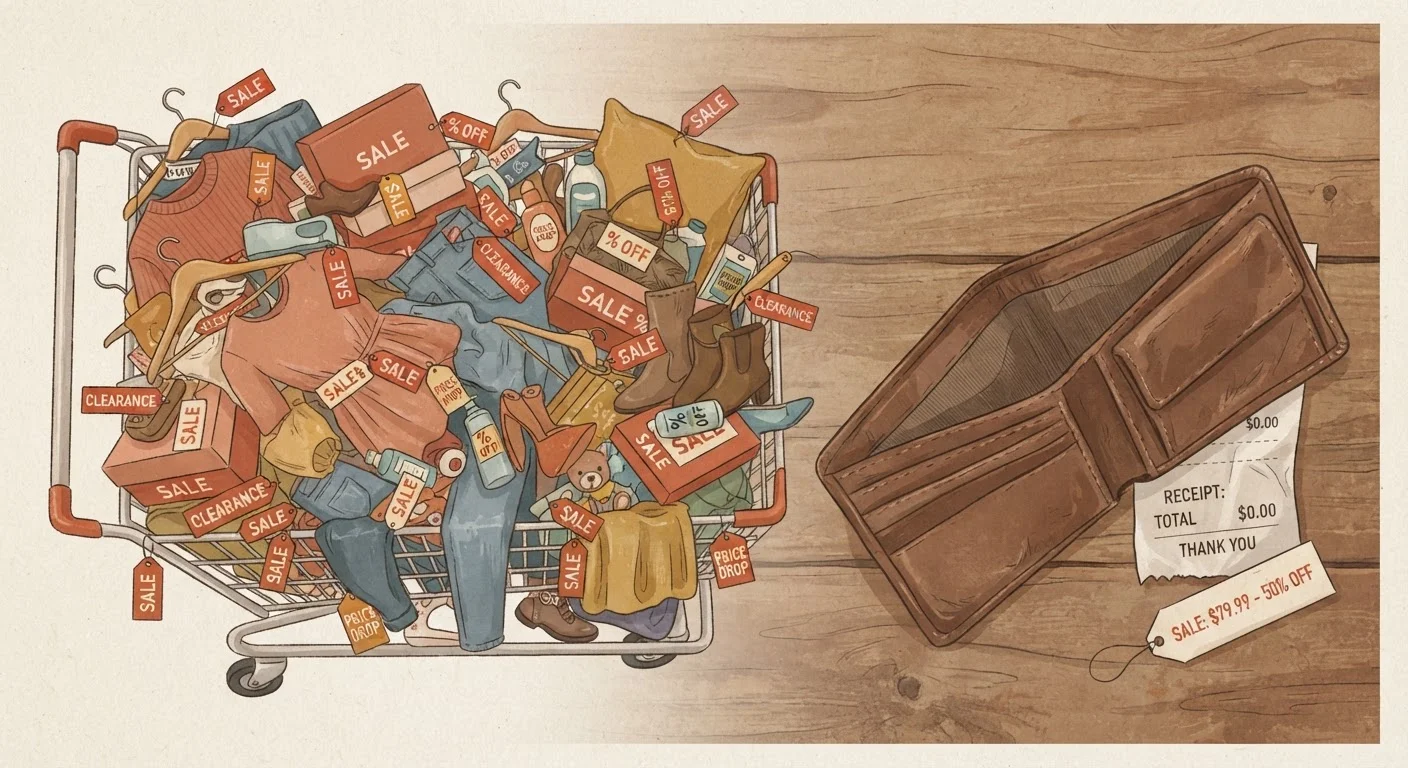
Why Deal-Hunting Instincts Can Work Against You
The desire to find a good deal is entirely rational - but many widely held beliefs about what a deal actually is can quietly undermine sound financial judgement. When a shopping habit is built on a myth, every purchase made under that assumption has the potential to cost more than it saves.
This article examines the most common misconceptions people carry into their shopping decisions. Each one feels logical on the surface, which is precisely why it does so much damage. For a broader look at the beliefs that stall saving altogether, see common money myths that keep people from saving.
Myth
If something is on sale, buying it saves me money.
Fact
A sale only generates savings when you would have purchased the item anyway at full price. Buying something solely because it is discounted is spending, not saving.
Retailers mark items as "on sale" to create urgency and a sense of financial prudence. But the money you spend on a discounted item you didn't need is still gone. The relevant comparison is not the original price versus the sale price - it is the sale price versus zero, which is what you spend when you don't buy it at all.
Myth
Loyalty programmes always reward regular customers.
Fact
Loyalty programmes are designed to increase purchase frequency and total spend. The rewards earned often return less value than the extra spending they encourage.
Points, miles, and rewards tiers create a psychological pull toward spending more to reach the next level. Consumer behaviour research consistently finds that loyalty programme members spend more per visit than non-members - frequently more than the rewards are worth. Before treating a loyalty programme as a benefit, consider whether membership has changed how much you spend at that retailer.
Myth
Coupons always put money back in your pocket.
Fact
Coupons regularly direct spending toward products you wouldn't otherwise choose, or require minimum purchases that push total spend above what you'd planned.
A coupon for a product you don't use isn't savings - it's a marketing tool that changes your behaviour. Even coupons for items you do buy often come with conditions: minimum quantities, minimum spend, or short expiry windows that force a trip you wouldn't have made. Evaluate any coupon against what you would have actually spent without it.
Myth
Buying in bulk is almost always the smarter financial choice.
Fact
Bulk buying saves money only when the unit price is genuinely lower and the quantity will actually be used before it expires or deteriorates.
The appeal of bulk purchasing is real in specific circumstances - non-perishable items with a confirmed use case and clear unit-price savings. But food waste, storage costs, and the reality that many bulk purchases involve items that go unused erode the apparent discount quickly. For an honest breakdown of when bulk buying works and when it doesn't, see why bulk buying isn't always the win it appears to be.
Myth
Free shipping means I'm getting a better deal.
Fact
Free shipping is almost always factored into the item price, a minimum-spend requirement, or a membership fee - it is rarely a genuine bonus at zero cost.
When free shipping requires a minimum purchase, the effective question is whether the extra items you added to hit the threshold were worth their full price. A $6 shipping fee avoided by adding a $15 item you didn't need is not a saving - it's a net loss of $9. When free shipping is included in a paid membership, the cost of that membership should be weighed against actual usage across the year.
The Numbers Behind Deal Psychology
Understanding why these myths persist requires a brief look at how retailers structure promotions. Price anchoring - displaying a high "original" price next to a lower "sale" price - is a well-documented retail technique. The contrast makes the discount feel significant even when the reference price was never realistic. Before accepting any marked-down price at face value, it helps to check what the item actually sells for across different retailers.
~40%
Of items bought on impulse during sales
Consumer research from various retail studies suggests roughly four in ten unplanned purchases are triggered by promotional pricing rather than genuine need.
2-3x
Typical loyalty member spend vs. non-member
Multiple retail analyses have found loyalty programme members spend significantly more per transaction on average, often without commensurate reward value.
Minimum-spend thresholds deserve particular attention. A coupon offering $10 off a $50 purchase sounds attractive, but if you only needed $30 worth of items, you've spent $20 extra to claim $10 back. Similarly, free shipping triggers that activate at a spending threshold routinely push consumers past what they intended to buy. For a deeper examination of how promotional terms shape real value, the fine print of offer terms and conditions is worth reviewing before committing to any promotion.
Minimum-Spend Thresholds Are a Spending Trigger
When an offer requires you to spend a set amount to unlock a discount or free shipping, the retailer is counting on you to add items you wouldn't otherwise buy. Before adding to your cart to hit a threshold, calculate whether the extra items are genuinely worth their individual prices - not just useful as a means to an end.
Building a More Honest Shopping Framework
The antidote to deal myths is not scepticism about every purchase - it is a clearer definition of value. Price and value are genuinely different concepts. An item that costs less but fails quickly, goes unused, or was never needed is not a saving. The true meaning of good value is a useful frame to apply before any significant purchase.
A practical starting point: before acting on any promotion, ask whether you would purchase this item today at full price. If the answer is no, the deal is manufacturing a want rather than meeting a need. Tracking where your money actually goes - across subscriptions, convenience spending, and impulse purchases - often reveals how much is lost to deal-driven decisions. The patterns quietly draining your savings are worth mapping before your next shopping trip.
The Best Deal Is Often No Purchase
Every deal myth shares a common thread: it reframes unnecessary spending as financial responsibility. The clearest test of any promotion is whether you would make the same purchase at full price, without the discount. If the honest answer is no, the deal is working against your financial interests - not for them. This is general financial information; for guidance specific to your situation, consider consulting a qualified financial professional.
Deal literacy is a skill, not a personality trait. With a clearer framework, the habits that feel like saving can be separated from the ones that quietly cost more. For a wider view of smart consumer decisions, the shopping tips hub covers practical strategies across everyday purchases.