
The Anchor Is Set Before You Pick Up the Item
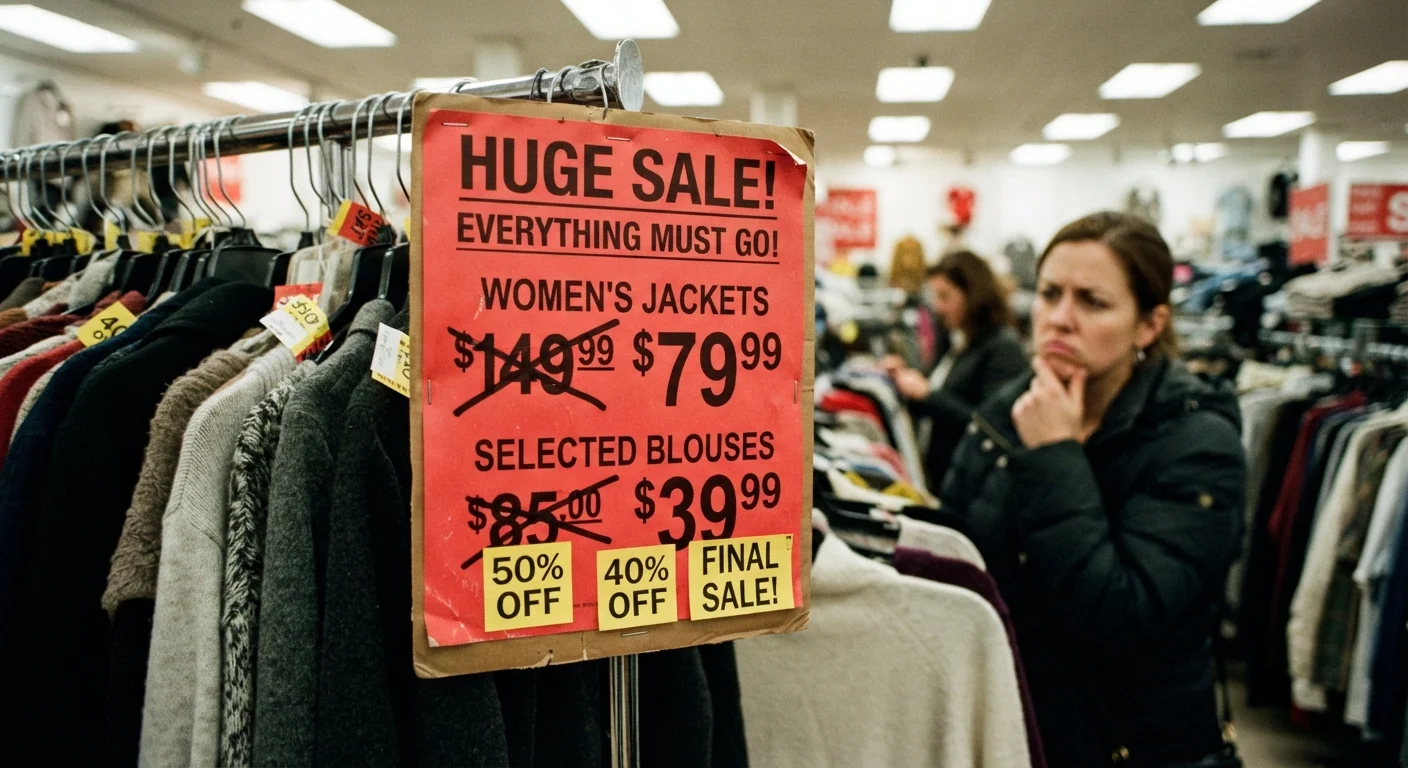
The moment you see a price tag showing $120 crossed out next to $79, your brain has already formed a judgment. The crossed-out number - called an anchor - becomes the mental baseline against which every other number is measured. You aren't evaluating whether $79 is a fair price for the item; you're evaluating whether $79 is a good deal relative to $120.
This distinction matters enormously. Anchoring works because our brains are built to make relative comparisons rather than absolute ones. Retailers know this and price accordingly. Reference prices - sometimes labeled "compare at," "was," or "MSRP" - are legal as long as they reflect some genuine prior pricing, but the standards for what qualifies vary. The practical takeaway: a crossed-out price is a framing device first, and factual information second.
Reference Prices Are Not Always Reliable
In the US, the FTC provides general guidelines on deceptive pricing, but enforcement and standards vary. A "was" price legally needs to reflect a genuine prior offer, but the specifics of what qualifies differ by context. Treat reference prices as one data point rather than verified fact.
Awareness Reduces But Doesn't Eliminate Bias
Research in behavioral economics suggests that knowing about a cognitive bias does not fully inoculate against it. Anchoring, for instance, affects trained economists and novice shoppers alike. Structural habits - like waiting periods or pre-set budget limits - tend to be more effective than knowledge alone.
One useful habit is to mentally strip away the reference price and ask: Would I consider buying this if the tag only showed $79, with no comparison? That single shift in framing can clarify whether the deal is compelling or whether the anchor is doing most of the persuasive work.
How Urgency and Scarcity Override Rational Thinking
"Only 3 left in stock." "Sale ends in 02:14:07." These cues are designed to activate a specific psychological response: loss aversion. Behavioral economists have consistently found that the pain of losing something feels roughly twice as powerful as the pleasure of gaining an equivalent thing. Scarcity and time pressure convert a purchasing decision into a potential loss - and loss aversion tends to win.
The result is a narrowed decision window. When urgency is present, the brain shortcircuits the slower, more deliberate evaluation process and defaults to a fast, emotionally driven response. This is why you can walk into a store intending to browse and walk out with something you hadn't planned to buy - the environment was structured to make waiting feel costly.
Try the 24-Hour Rule Before Buying
When you encounter a time-limited offer, resist completing the purchase immediately. Wait 24 hours and revisit the decision. Most deals either extend or return, and the urgency you felt is likely to subside - giving you a clearer read on whether you actually want the item.
It's also worth noting that digital retail has made these cues more sophisticated. Personalized urgency - "Only 2 left at this price for your size" - adds specificity that makes the pressure feel more credible and more personal.
~2x
How much more strongly losses are felt vs. equivalent gains
Loss aversion, a finding from Kahneman and Tversky's prospect theory research, is one of the most replicated results in behavioral economics.
60%+
Shoppers who report buying more than planned during sales events
Surveys consistently show that promotional environments lead a majority of shoppers to exceed their original intended spend.
Varies widely
How often "original" reference prices reflect actual prior selling prices
Consumer advocacy research has found that reference pricing practices differ significantly by retailer, with some using prices at which items were rarely or never sold.
Framing: Why the Same Discount Can Feel Completely Different
A $10 discount on a $30 item (33% off) and a $10 discount on a $200 item (5% off) involve the same absolute savings. But they feel very different - and retailers choose their framing accordingly. This is the framing effect: how information is presented shapes how it is perceived, independent of the underlying facts.
For lower-priced items, percentage discounts tend to look more impressive. For higher-priced purchases, dollar amounts often feel more tangible. Retailers tend to use whichever framing makes a given discount appear largest. Understanding this doesn't require math - it just requires pausing long enough to translate the discount into the format the retailer didn't use, and seeing how it feels then.
Similarly, "buy two, get one free" and "33% off each item" describe the same economic reality but register differently in the mind. Bundled offers often obscure actual per-unit cost, particularly when they push buyers to purchase more than they originally planned. For a broader look at how common shopping beliefs quietly undermine budgets, see why "sale" doesn't always mean savings.
“It is not the objective value of the options that determines choice, but their representation in the mind of the chooser.”
— Daniel Kahneman, Nobel laureate and author of research on cognitive biases and decision-making
Building Habits That Work With - Not Against - Your Brain
Awareness of these tactics is a starting point, but habits provide more reliable protection. A few approaches are grounded in behavioral research:
- Impose a waiting period. A 24-hour pause between seeing a deal and completing the purchase disrupts the urgency loop. Most time-limited deals either extend or recur.
- Set an independent value ceiling. Before shopping, decide what you'd willingly pay for a category of item. If the sale price exceeds your ceiling, the anchor is irrelevant.
- Ask the substitution question. If the item weren't on sale, would you be seeking it out today? A "no" answer suggests the deal - not the need - is driving the purchase.
- Separate the item from its presentation. Read product descriptions without looking at the price first when possible. Form an impression of the item before anchoring takes hold.
These habits won't make you immune - cognitive biases are persistent even in informed consumers. But they introduce the deliberate pause that pricing environments are specifically designed to eliminate. If you want to go deeper on the impulse side of the equation, the psychology behind impulse buying covers the broader patterns at work. And before any non-essential purchase, a pre-purchase checklist can help you separate a genuine want from a retailer-manufactured one.