
Why These Myths Stick Around
Meal planning has a perception problem. The version most people encounter - elaborate batch-cooking spreads, color-coded containers, hours of prep - sets an unrealistic standard that makes the practice feel inaccessible before they've even tried it. When the idealized version doesn't match real life, it's easy to conclude that meal planning simply doesn't work for you.
The truth is that most meal planning myths are rooted in an overly rigid interpretation of what planning actually means. Planning is fundamentally about reducing friction - knowing in advance what you'll eat, what you need to buy, and roughly when you'll cook. Everything beyond that is optional. Understanding where the misconceptions come from is the first step to building a version of meal planning that sticks.
Myth
Meal planning requires spending your entire Sunday in the kitchen doing elaborate prep.
Fact
A functional plan can be built in 20-30 minutes and doesn't require cooking a single dish in advance.
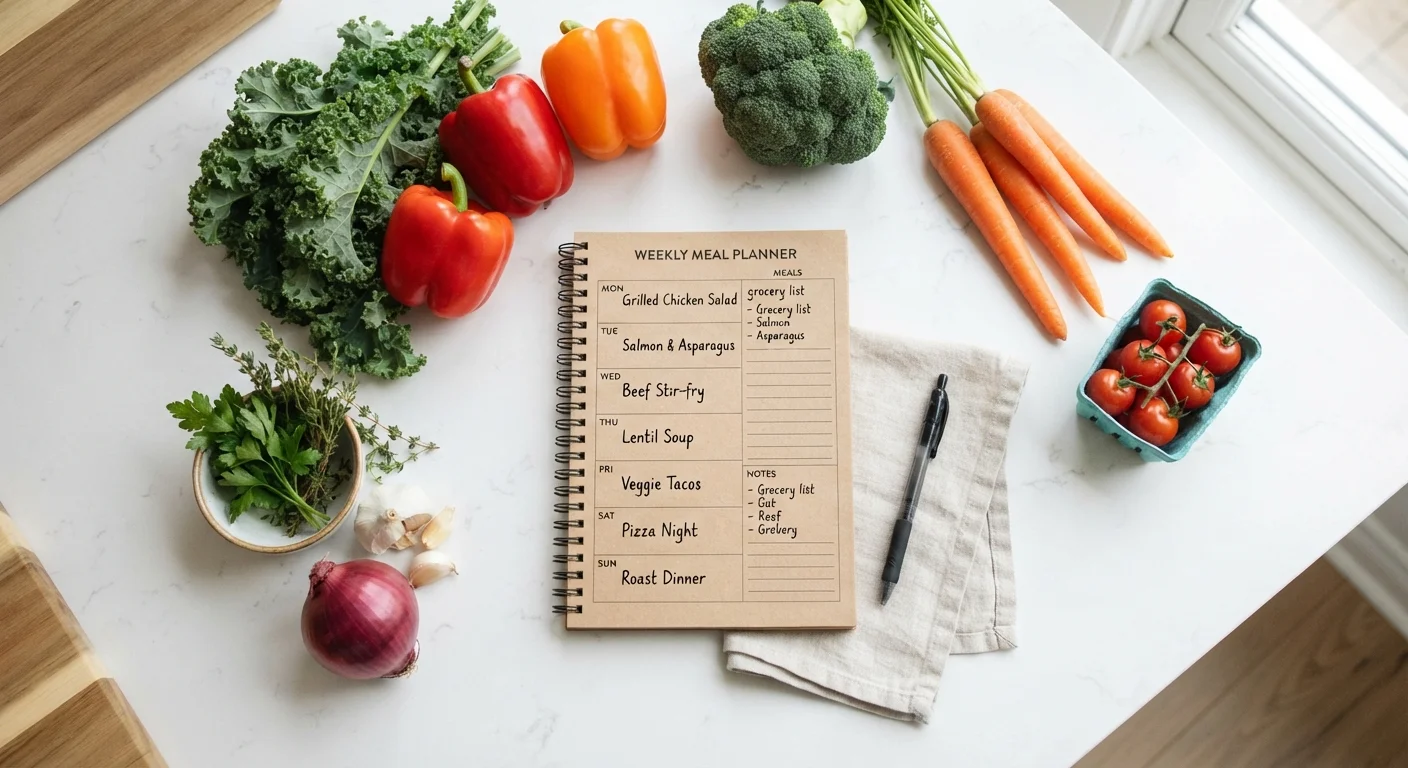
The "full Sunday prep" image - with rows of identical containers stacked in a spotless fridge - is more social media aesthetic than practical necessity. Real meal planning starts with a short weekly review: check what's in your pantry, sketch out five or six dinners, and write a grocery list. That's it. Chopping, cooking, or portioning in advance is optional and useful only if it genuinely fits your schedule. For many people, simply knowing what they'll cook is enough to eliminate the 6 p.m. "what's for dinner?" scramble.
Myth
Meal planning means eating the same boring meals on repeat every single day.
Fact
Planning ahead actually creates room for more variety, not less, because you're choosing intentionally instead of defaulting to the same few easy meals.
Without a plan, most people rotate through four or five familiar meals by habit. A written plan prompts you to deliberately introduce a new protein, a different cuisine, or a seasonal vegetable you might otherwise overlook. You can also build in "flex nights" - one or two evenings where leftovers, takeout, or whatever sounds good fills the gap. Variety is a design choice within any plan, not something planning takes away.
Myth
Meal planning is only practical if you have a generous grocery budget.
Fact
Planning ahead typically reduces food spending by lowering impulse purchases and cutting down on food that spoils before it's used.
Shopping without a list is one of the fastest ways to overspend. A plan tied to a shopping list means you buy what you'll actually use. Batch-cooking inexpensive staples - dried beans, grains, eggs, frozen vegetables - stretches a modest budget further than buying prepared or convenience foods. The USDA estimates that American households waste a significant portion of the food they purchase; a structured plan directly addresses that leak. See how to build a flexible framework that keeps costs predictable week to week.
Myth
If you miss a day or deviate from the plan, the whole week is ruined.
Fact
A meal plan is a guide, not a contract - skipping or swapping one meal doesn't invalidate the rest of the week.
All-or-nothing thinking is one of the most common reasons meal plans get abandoned entirely. Life interrupts: work runs late, a friend invites you to dinner, or you simply don't feel like cooking what you planned. The practical fix is to treat your plan as a menu of options rather than a fixed schedule. Move Tuesday's dinner to Thursday, swap proteins between two meals, or use planned ingredients in a different dish. Why plans collapse mid-week - and how to recover - is worth understanding before you start.
Myth
You need to be a skilled cook or follow complex recipes for meal planning to work.
Fact
The simplest plans - built on a handful of versatile, low-effort recipes - are the most sustainable over time.
Complexity is the enemy of consistency. A rotation of ten reliable recipes you already know how to make is more useful than an ambitious weekly menu you'll abandon after two weeks. Start with what you cook confidently: a stir-fry base, a sheet-pan protein and vegetable, a soup or stew. From there, small variations - different sauces, swapped vegetables, new grains - add variety without demanding new skills. If you're new to the process, meal planning from scratch walks through the core concepts step by step.
Building a Realistic Approach Instead
Planning Is a Tool, Not a Rule
Meal planning is meant to reduce decision fatigue and food waste - not to lock you into a rigid schedule. If your plan needs adjusting mid-week, that's normal and expected. A plan that bends without breaking is far more useful than one you abandon by Tuesday.
Once the myths are cleared away, what remains is a much more manageable picture. Effective meal planning looks different for every household - some people plan only dinners; others map out every meal and snack. Neither approach is wrong. The goal is to find the level of structure that reduces stress without adding new obligations.
A useful starting point: plan for the number of meals you realistically need to cover, not an ideal version of your week. If you eat lunch out three days a week, plan two lunches. If Friday is always unpredictable, leave it open. A structured weekly checklist can help you move through the planning process efficiently without overlooking anything important.
~30-40%
Food wasted by the average US household
The USDA and EPA have both estimated that American households discard a substantial share of their purchased food, much of which stems from unplanned buying and poor storage.
20 min
Typical time needed for a functional weekly plan
Nutrition educators and meal planning practitioners generally suggest that a basic weekly dinner plan - including a shopping list - takes under 30 minutes for most households.
For those weighing how much to prep in advance versus cooking fresh each day, batch cooking vs. daily prep offers a practical comparison. And if nutritional balance feels like a separate, overwhelming concern, what balance actually means in a weekly plan brings that concept down to an approachable, practical level.
This article is for general informational purposes only and is not a substitute for guidance from a registered dietitian or qualified healthcare professional regarding your individual nutritional needs.