
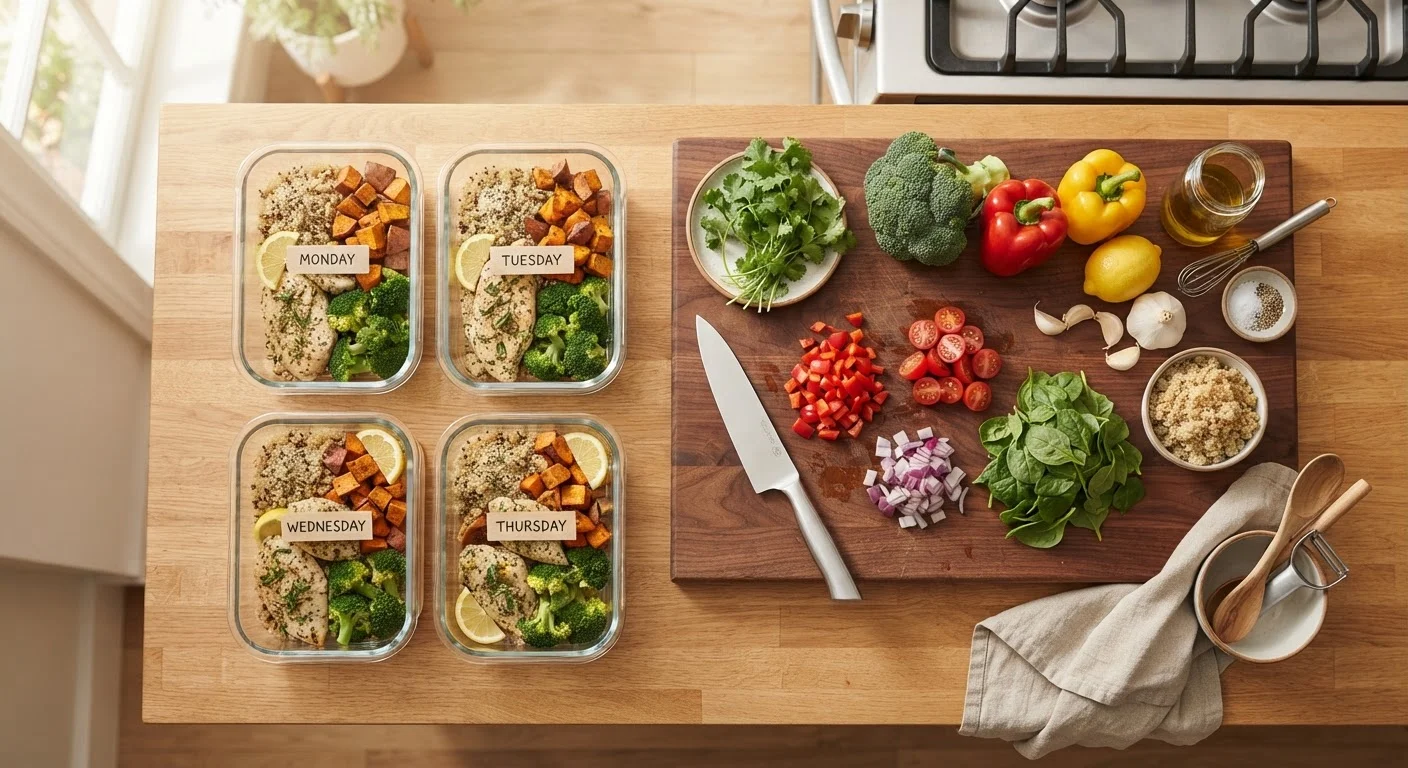
What Each Approach Actually Involves
Batch cooking means dedicating one session - typically a few hours on a weekend - to preparing large quantities of food that gets stored and eaten across several days. Think a pot of grains, roasted vegetables, a protein or two, and maybe a soup. Meals are then assembled from those components throughout the week with minimal additional cooking.
Daily prep, by contrast, means cooking each meal (or at least the main meal) fresh, either the morning of or in the 20-40 minutes before eating. Shopping may happen more frequently, and each cooking session is shorter but more regular.
If you're new to structuring your meals this way, the fundamentals of meal planning are worth reviewing before committing to either method.
| Criterion | Batch Cooking | Daily Prep |
|---|---|---|
| Time pattern | One large weekly session | Shorter sessions each day |
| Weeknight effort | Very low (reheat and assemble) | Moderate (20-40 min cooking) |
| Food freshness | Declines over storage days | High - cooked to order |
| Menu variety | Limited without remixing strategy | High - changes daily |
| Grocery frequency | Once weekly, larger shop | More frequent, smaller trips |
| Best household size | Families or multi-person households | Individuals or couples |
| Schedule flexibility needed | One free block per week | Daily availability required |
The Real Trade-Offs: Time, Freshness, and Variety
The most common argument for batch cooking is time efficiency - but that efficiency is front-loaded. You spend more time on Sunday so you spend almost none on Tuesday. For people with demanding weeknights, that trade is often worth it.
Daily prep distributes effort more evenly. This suits people who genuinely enjoy cooking and don't mind the daily commitment, or those who live alone and only need to make smaller portions. However, it depends on consistent availability each day - which many busy schedules simply don't guarantee.
~2-3 hrs
Typical weekly batch cooking session
Most batch cooking advocates report spending two to three hours once a week to cover the majority of weekday meals.
68%
Adults who say time is their #1 cooking barrier
According to general food behavior research, lack of time is consistently cited as the leading reason adults skip home cooking on weeknights.
Variety is where batch cooking gets its reputation for monotony. Eating the same chicken and rice for four days isn't inherently bad, but it does require a certain tolerance - or a strategy for remixing components into different dishes. Daily prep sidesteps this naturally.
Freshness matters more for some foods than others. Leafy greens, eggs, and fish tend to suffer in storage. Grains, legumes, roasted root vegetables, and braised proteins hold up well for three to five days when stored properly.
For a practical breakdown of how to structure either approach across the week, the flexible meal planning framework offers useful scaffolding.
How to Decide - and How to Combine Both
Ask yourself three questions before choosing:
- Do you have one reliable free block of 2-3 hours per week? If yes, batch cooking is viable. If your schedule shifts unpredictably, daily prep may be more realistic.
- How much does food texture and freshness matter to you? If reheated food feels like a compromise, daily prep will serve you better. If function matters more than the fresh-cooked experience, batch cooking works.
- How many people are you feeding? Larger households almost always benefit from batch cooking - the math of feeding four people fresh meals every night rarely works sustainably.
Storage Safety Is Non-Negotiable
Batch-cooked food should be cooled quickly and stored in airtight containers in the refrigerator within two hours of cooking. Most cooked proteins and grains keep safely for three to four days; soups and stews may last up to five. When in doubt, follow USDA food safety guidelines for refrigerator storage times. Freezing extends shelf life significantly for most batch-cooked dishes.
Many people find the most durable solution is a hybrid approach: batch-cook a few versatile base components (grains, a protein, a sauce) and then do light daily prep - a fresh salad, a quick sauté, or a fried egg - to complete the meal. This captures the efficiency of batch cooking while preserving some of the freshness and variety of daily cooking.
See how to build a weekly meal plan you'll stick to for a practical, step-by-step way to put either approach into action. And if you've avoided meal planning because it felt too rigid or time-consuming, the common meal planning myths article addresses those concerns directly.