
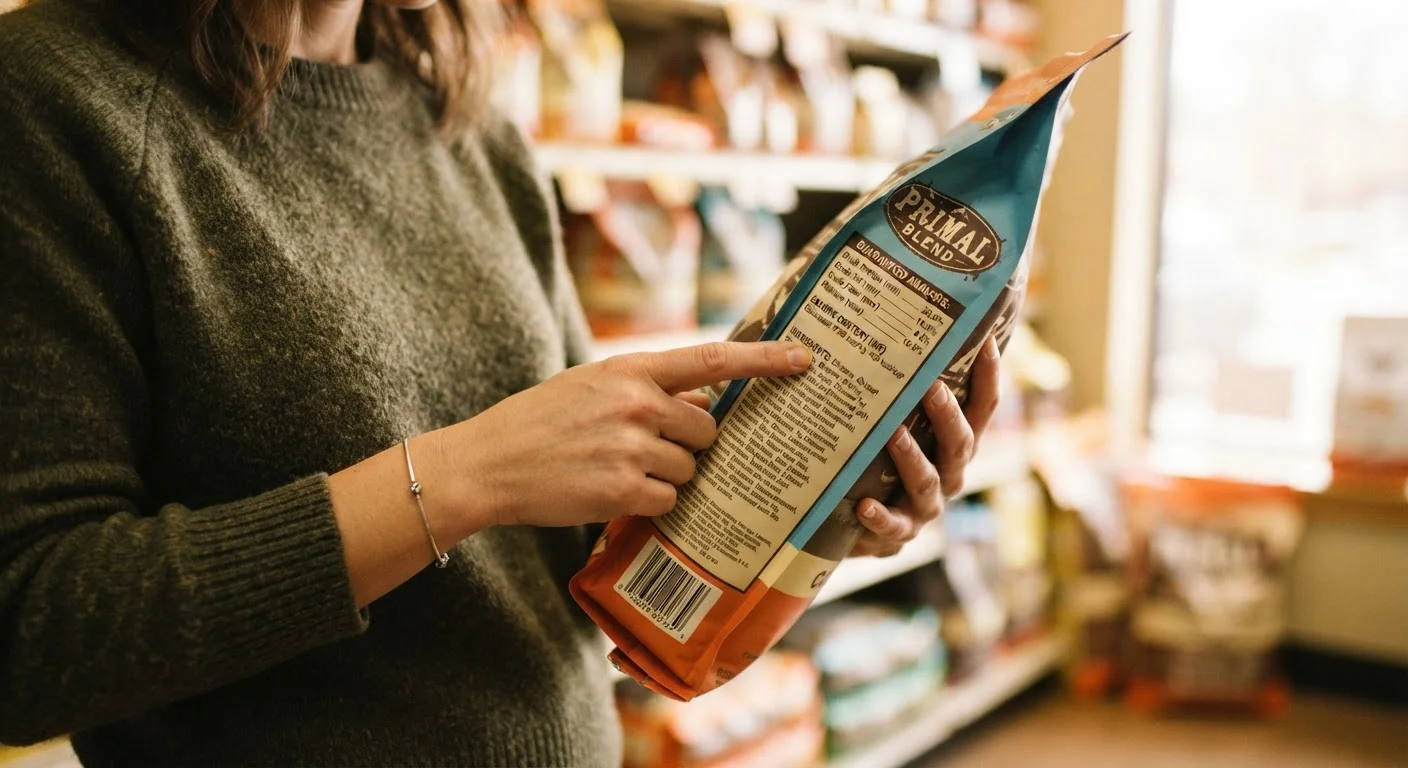
Why Pet Food Labels Are Worth Your Attention
Most pet owners glance at the front of a food bag - the imagery, the bold claims - and move on. The real information, however, lives on the back or side panel. Pet food labels in the US are regulated by both the AAFCO and individual state feed control agencies, which means certain disclosures are legally required. Learning to read them is one of the most practical things you can do for your animal's long-term wellbeing.
For a broader look at how these habits fit into everyday pet ownership, see our guide to daily pet care habits.
| US regulatory bodies | AAFCO + individual state feed control agencies |
| "Chicken" in name requires | ≥95% chicken (excluding water) (AAFCO model regulations) |
| "With Chicken" requires | ≥3% chicken (AAFCO model regulations) |
| Ingredient list order | Descending by pre-cooking weight |
| Life stages on labels | Growth, adult maintenance, all life stages, supplemental (AAFCO definitions) |
| "Holistic" / "Premium" terms | No standardized AAFCO definition |
The Five Core Sections of Any Pet Food Label
1. Product Name
The name itself carries regulatory weight. AAFCO rules dictate that specific wording changes what the product must contain. If a label reads "Chicken Cat Food," chicken must make up at least 95% of the product (excluding water). A label reading "Chicken Dinner" or "Chicken Entrée" only requires 25% chicken. "With Chicken" drops that threshold to just 3%. "Chicken Flavor" means only a detectable amount is required - it could be a very small percentage.
2. Ingredient List
Ingredients are listed by pre-cooking weight in descending order. This matters because a meat ingredient listed first may still be outweighed by combined grains listed below it. Look for named protein sources ("chicken," "salmon") rather than vague terms ("poultry by-product meal"). By-products are not inherently harmful - they include organ meats - but specificity generally signals higher quality sourcing transparency.
AAFCO
The Association of American Feed Control Officials - a nonprofit organization that establishes model regulations for pet food ingredients, labeling, and nutritional standards adopted by most US states.
Guaranteed Analysis
A required label section listing minimum crude protein and fat, and maximum crude fiber and moisture. These are regulatory guarantees, not exact nutrient measurements.
Crude Protein
A laboratory measurement of total nitrogen in a food, used to estimate protein content. It includes protein from all sources, including plant-based ingredients.
Nutritional Adequacy Statement
A required label statement indicating whether a food is complete and balanced for a given life stage, and whether that was determined by AAFCO feeding trials or nutrient profile formulation.
By-Products
Secondary animal-derived ingredients such as organ meats, blood, and bone. They are regulated ingredients and not inherently low quality, though named sources are more transparent than generic terms.
Dry Matter Basis
A method of comparing nutrient levels between wet and dry pet foods by removing the moisture variable, allowing an apples-to-apples nutritional comparison.
3. Guaranteed Analysis
This section lists minimum percentages of crude protein and crude fat, and maximum percentages of crude fiber and moisture. Note that these are guarantees, not exact values. Comparing wet and dry foods directly using these numbers can be misleading due to moisture differences; a nutritional dry-matter basis calculation is needed for accurate comparisons (a veterinary nutritionist can assist with this).
4. Nutritional Adequacy Statement
This is arguably the most important line on the label. It states whether the food is "complete and balanced" for a specific life stage - adult maintenance, growth, all life stages, and so on. It also tells you how that was determined: either through AAFCO feeding trials or by formulation to meet AAFCO nutrient profiles. Feeding trials involve real animals eating the food; formulation-based statements are calculated on paper.
5. Feeding Guidelines
These are starting-point suggestions, not precise prescriptions. They are based on average animals and don't account for your pet's individual metabolism, activity level, or health status. Use them as a baseline, then adjust based on body condition - and consult your veterinarian before making significant dietary changes. Our article on free-roaming vs. scheduled feeding covers how feeding method also plays a role.
95%
Minimum named ingredient required for single-protein label
Under AAFCO's "95% rule," a food named after one ingredient must contain at least 95% of that ingredient, excluding added water.
25%
Threshold for "Dinner," "Entrée," or "Platter" named foods
AAFCO's "25% rule" applies when the product name includes a descriptor like dinner, entrée, or formula alongside an ingredient name.
Common Label Claims - and What They Actually Mean
Front-of-bag language is largely marketing territory. Terms like "natural," "holistic," and "premium" have no standardized AAFCO definitions and carry no regulatory requirements. "Natural" does have a loose AAFCO guideline - it generally means ingredients are not chemically synthesized - but enforcement varies. "Grain-free" simply means no corn, wheat, rice, or similar grains; it does not automatically mean lower carbohydrate content, as legumes and potatoes are often substituted.
"Human-grade" is meaningful only if the facility is licensed to produce food for human consumption. Otherwise it is an unverified claim. "Organic" has USDA-defined meaning when certified, so it's one of the more reliable front-panel terms.
If you're also sharpening your label-reading skills for your own food, the approach shares some overlap - our nutrition labels guide for human food explains the logic behind ingredient ordering and daily values in familiar terms.
Label Reading Has Limits - Your Vet Fills the Gap
Pet food labels provide useful information, but they can't account for your individual animal's health conditions, allergies, or life-stage transitions. This article is general educational information, not veterinary advice. Always consult a licensed veterinarian or veterinary nutritionist before making significant changes to your pet's diet, especially for puppies, kittens, seniors, or animals with medical conditions.
Understanding how your pet communicates comfort or distress is equally important to feeding them well. See what your pet's body language is telling you to round out your awareness.